
Duchesne Projected Versus Actual Release
A projected or scheduled date is a future plan based on the current sentence, orders, credits, and holds. An actual release date records what occurred after staff finished processing. The two can match, but they answer different questions. A Board parole date authorizes a future state release subject to later action. It does not prove the person left on that date. The newest Board order and UDC confirmation are needed after the date passes.
Pretrial detainees are different. A person awaiting a Duchesne County case does not have a sentence from which staff can calculate a fixed release day. Bond, recognizance, dismissal, a later hearing, a new hold, or a court order can change custody. The docket explains the legal action. The Sheriff record gives the completed jail release or transfer time.
Find Duchesne County Release Dates
Start with custody type. Duchesne County Jail holds local detainees and Utah state contract inmates, so the building alone does not identify which release rules apply. A local sentence begins with the court commitment and Sheriff calculation. A UDC sentence begins with the state offender record and the Board. Federal and immigration holds require their own systems.
- Identify whether the person is pretrial, county sentenced, under UDC jurisdiction, federal, or held for immigration custody.
- For a local case, read the court commitment, sentence, credit for time served, and any later orders.
- Ask Duchesne County Jail how it applied lawful county credit and whether another hold exists.
- For a state prisoner, search by UDC number when possible and copy the exact date label shown.
- Open the newest Utah Board decision and every later modification or rescission.
- When the planned day passes, confirm the actual event with the agency that had custody.
The full Duchesne County released inmate search explains how to trace a completed release record. A future-date check stops short of confirmation until the custodian records what actually happened.
UDC Duchesne Release Date Search
The UDC Offender Search accepts a UDC number or a name. A number is more precise. A name search requires at least one letter in both first- and last-name fields, after which identity details must be compared with care. The tool covers only people currently under UDC supervision. That scope includes prison, felony probation, and parole, but excludes a person merely awaiting trial in Duchesne County Jail.
Copy the live result's exact wording. UDC public information identifies “Parole/Expiration Date” as a releasable field, while UDC release guidance tells readers to verify a “Parole/Release date.” Do not rename the field to “projected release date” if the result does not use that label. A person who fully discharged may no longer appear because the search is not an all-time archive. In that case, seek the historic Board termination order or a focused UDC record.
The official Utah offender-search entry screen shows the current search route and scope notice.
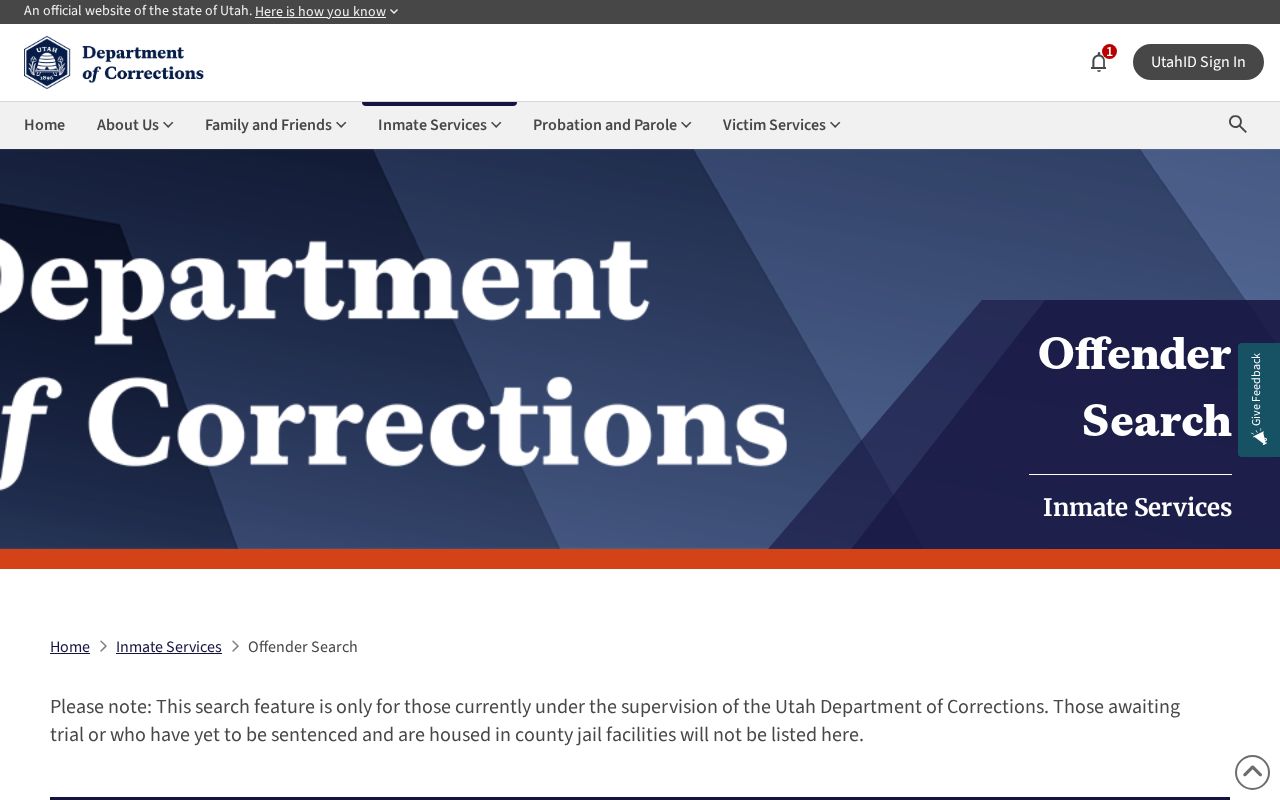
The scope text is as important as any returned date because it explains why a fully discharged person or unsentenced local detainee may not appear.
Note: A UDC result can show a parolee after prison release because parole remains state supervision rather than final discharge.
Duchesne Parole Date Decisions
Utah generally uses indeterminate prison sentences. Under Utah Code § 77-18-111, a prison sentence is read as the statutory minimum-to-maximum term unless the Board sooner terminates or commutes it. The Board of Pardons and Parole therefore makes a release decision within that legal range. The date is not found by subtracting a simple fixed term from the commitment date.
Use the Board hearing and decision search by offender number when known. Sort decisions in time order and read the newest action. An original hearing may set parole or a rehearing. A rescission hearing may take back a granted date before release. A later paper review or special-attention order may change the prior result. A termination order is different from a parole grant because termination can end sentence or supervision authority.
- Original hearing
- The first main review of release before sentence expiration.
- Rehearing
- A later date for another release review, not a release itself.
- Rescission
- A process that can remove a date already granted before release.
- Termination
- An order that may conclude parole or sentence authority.
Two Duchesne Time-Credit Systems
Duchesne County cases can involve two distinct time-credit systems. The first is local. Utah Code § 76-3-403 permits the custodial authority, in its discretion and for good behavior, to allow qualifying county-jail commitments up to ten days of credit for each thirty days served. For a period under thirty days, it permits up to two days per ten days. The statute has exclusions, and the words “may” and “up to” prevent a fixed automatic formula.
The second system applies to UDC prisoners. Utah Code § 77-27-5.4 and the UDC earned-time program allow qualifying program completion to reduce a date already ordered by the Board. A qualifying program generally produces a four-month reduction, while a qualifying substance-use program can produce eight months, subject to eligibility, usable time, and Board implementation. It is not a free-standing sentence calculator.
A state contract inmate housed at Duchesne County Jail remains under UDC jurisdiction. Running that person's date through the county-jail good-behavior formula would mix two legal systems. Identify the sentencing authority first. Then apply only the statute and record that govern that custody.
The state earned-time explanation illustrates why the reduction attaches to a Board-ordered date.
The program page supplies state-prison mechanics only. It should not be applied to a local Duchesne jail commitment.
No Universal Duchesne 85% Rule
Utah cannot be reduced to a claim that every prisoner serves eighty-five percent. The researched Utah sources do not establish a universal rule of that kind. State prison dates instead combine statutory ranges, offense-specific minimums, Board authority, release restrictions, and earned-time law. County jail credit follows a different statute and remains discretionary within its terms.
For a prison case, read the law tied to the conviction and sentence. Utah Code § 77-27-9 restricts release before an applicable minimum unless the required findings and hearing occur, and it includes special rules for listed offenses. The Board order then shows how those rules were applied. A federal conviction has its own federal minimum and good-conduct framework, which should not be blended into a Duchesne or Utah calculation.
Note: A percentage copied from a generic calculator is not evidence of a Duchesne County or UDC release date.
Duchesne Release Dates Can Change
A planned release rests on current facts. Changes in those facts can move the date or alter what happens on that day. Some factors affect how much time remains. Others let a second authority take custody even after the first sentence or hold ends.
| Factor | Possible effect | Record to check |
|---|---|---|
| Later court order | Changes sentence, credit, stay, or release authority. | Duchesne court docket and commitment. |
| County good-behavior credit | May shorten a qualifying local commitment within statutory limits. | Sheriff time computation and § 76-3-403. |
| UDC earned time | May reduce a Board-ordered state date for eligible program completion. | UDC record and Board order. |
| Board modification or rescission | Can move or remove a future parole date. | Newest Board decision. |
| Detainer or hold | Allows another authority to continue custody. | Release disposition and receiving-agency record. |
| New case or discipline | Can affect local calculation, Board action, or actual processing. | Court, jail, UDC, and Board records as applicable. |
A detainer is a request or authority for another agency to hold or receive a person. It can turn a planned community release into a transfer. Always ask for the destination on the final release record.
Duchesne State Release Processing
UDC centralizes most state release processing. Its Release Day guidance says releases and paroles are normally processed on Tuesdays at the Utah State Correctional Facility. Almost all state prisoners housed in county contract beds are first moved there. Direct release from a contract jail is described as extremely rare, with family notified if it applies.
This is a key Duchesne County distinction. A state prisoner can disappear from the local jail before the planned date because UDC transferred the person to Salt Lake City. The move is continued state custody. It is not release to the community. People paroling to a Community Correctional Center are transported by UDC, while those without a private ride may receive later transport to a nearby TRAX station after arranged-ride releases.
The official UDC release-day page provides the current state logistics.
These rules apply to state release processing. Duchesne County Jail publishes no matching local release day, public waiting point, or routine transport promise.
Confirm Duchesne Actual Release
For a local sentence, compare the Duchesne court commitment with the Sheriff time calculation. Call the jail at 435-738-0190 for immediate routing. If written proof is needed, request the booking-and-release entry through the Sheriff GRAMA process, including the actual timestamp, disposition, releasing authority, and destination if public. The docket explains legal authority, while the jail record confirms completion.
For a UDC sentence, compare the live offender result with the newest Board decision and any later action. After the scheduled date, seek UDC confirmation. A pending-event alert can help, and the Duchesne County VINELink check explains the Utah verification warning. An alert should support, not replace, the correctional record.
Final discharge requires more than proof that prison doors opened. Parole can continue through the maximum sentence unless the Board terminates it earlier. A Board termination order or UDC discharge record is stronger proof that supervision and sentence authority ended.
An older state record may require that historic route because UDC Offender Search covers current supervision rather than every past prisoner. The Board's decision portal may retain a parole, modification, or termination order. If the needed order is absent, make a focused UDC or Board GRAMA request for the offender movement and release record, actual release date, release type, and termination status. For an older local sentence, the Sheriff record remains distinct from the state file, even if the person once occupied the same jail building.
Keep the date and its source together. “Parole date,” “expiration date,” “release date,” and “actual release timestamp” are not interchangeable labels. Quoting the official field makes later changes easier to trace and avoids presenting an estimate as a completed fact.