
Understanding Duchesne County Releases
“Released” marks the end of one custody episode. It does not always mean that the person walked into the community. A Duchesne County Jail record may show release on bond, a court-ordered release, time served, sentence completion, or placement in Pre-Trial Monitoring. It may instead show a transfer to the Utah Department of Corrections, another jail, a federal authority, or immigration custody. The release type and destination matter as much as the time stamp.
Different offices answer different parts of the question. The Sheriff records when physical custody at the local jail ended. A court docket explains the legal order, sentence, bond, or case result. The Utah Department of Corrections, or UDC, holds the state prison and felony supervision record. The Utah Board of Pardons and Parole issues parole and termination decisions. A person can be out of a cell yet still be on parole, probation, or local pretrial monitoring.
- Time served
- A court credits the jail time already served toward the ordered local term.
- Parole
- Release from prison before sentence expiration under Board authority and community supervision.
- Probation
- A court-ordered sentence served in the community under stated conditions.
- Discharge
- The end of custody and, in context, the end of supervision or sentence authority.
- Detainer
- A hold or request from another agency that can prevent a community release.
Duchesne County Release Paths
A release method points to the next useful record. Bond or a nonfinancial release allows the local criminal case to continue outside jail. A dismissal or acquittal may support release, but another warrant or case can still hold the person. Sentence completion ends the ordered jail term after lawful credit is applied. Parole changes state prison custody to UDC supervision. Transfer closes the Duchesne episode while another custodian keeps control.
| Release path | What it means | Best next source |
|---|---|---|
| Bond or recognizance | The person leaves jail while the case remains open. | Sheriff release entry and court docket |
| Time served | The court-ordered local term is met after applicable credit. | Commitment order and Sheriff time computation |
| Pre-Trial Monitoring | The person is outside the jail under local conditions. | Jail program contact and court case |
| Parole | The person leaves prison but remains under UDC supervision. | UDC Offender Search and newest Board order |
| Transfer | One jail episode ends while custody continues elsewhere. | Release destination and receiving agency locator |
| Expiration or discharge | The sentence or supervision authority ends. | UDC record, Board termination order, or custodian record |
Do not treat a court order as proof of the exact time jail staff completed processing. The court record explains legal authority. The custodian’s movement or release record proves when that agency stopped holding the person. Those two records are strongest when read together.
Duchesne Release Into Monitoring
The Duchesne County Jail information page identifies Pre-Trial Monitoring as a local alternative to confinement. A participant has physically left the jail’s cellblock. The criminal case or sentence has not necessarily ended. This is the key distinction behind a local release that still carries court or jail controls.
Ask whether the release disposition states monitoring, bond, sentence completion, or another ground. For program routing, the jail page lists operational and finance contacts. Court entries can show the order and conditions. The Sheriff release record supplies the time and disposition recorded at the jail. Calling a monitoring placement a discharge would erase the continued legal control that makes this Duchesne path distinct.
Duchesne County Release Record Fields
The county does not publish these person-level fields on its jail page. They must be requested from the Sheriff as a booking-and-release record or jail-management extract. Ask for the fields needed to identify the episode and tell release from transfer. Some may be protected or absent, so phrase them as requested fields rather than guaranteed results.
| Requested field | What it can establish |
|---|---|
| Legal name and aliases | Which person the entry concerns |
| Booking identifier | The specific custody episode tied to the request |
| Booking and release timestamps | When Duchesne physical custody began and ended |
| Charge and court case | The matter connected to the booking |
| Release disposition | Bond, court order, time served, monitoring, transfer, or another recorded outcome |
| Releasing authority | The office or order authorizing the change |
| Destination agency | Whether custody continued with UDC, another jail, BOP, ICE, or another authority |
A booking photograph is a separate request issue. Utah law requires a signed statement and allows protection in some cases. It is not proof of guilt, present custody, or release. Ask for the release fields even when no photograph can be supplied.
Request Duchesne County Release Records
Duchesne County directs Sheriff records requests through its Electronic Records page and the linked Sheriff NextRequest portal. The paper GRAMA form uses Duchesne County Sheriff’s Office, P.O. Box 985, Duchesne, UT 84021. That mailing address differs from the jail’s own mailing address, so use the form’s destination for a mailed records request.
- Identify the person with full name, known aliases, an approximate birth date if lawfully known, and a tight booking date range.
- Ask for the booking-and-release record, including the booking number, intake and release times, disposition, releasing authority, and public destination or transfer agency.
- State that an electronic copy is acceptable. Ask for a fee estimate before costs exceed a limit you choose.
- Submit through the Sheriff NextRequest portal or send the official paper form to the listed Sheriff address.
- If material is denied or redacted, ask for the record classification and the Utah law section supporting that decision.
P.O. Box 985
Duchesne, UT 84021
435-738-1529
jcarroll@duchesne.utah.gov
Utah Code § 63G-2-204 calls for requester contact details and a reasonably specific description. Duchesne states an ordinary response, denial, or extraordinary-circumstances notice is due within ten business days. Fees may be required in advance. Current cost should come from an estimate because the county’s older posted schedule may not control a new request.
The official portal itself is visible in the Duchesne Sheriff records system.
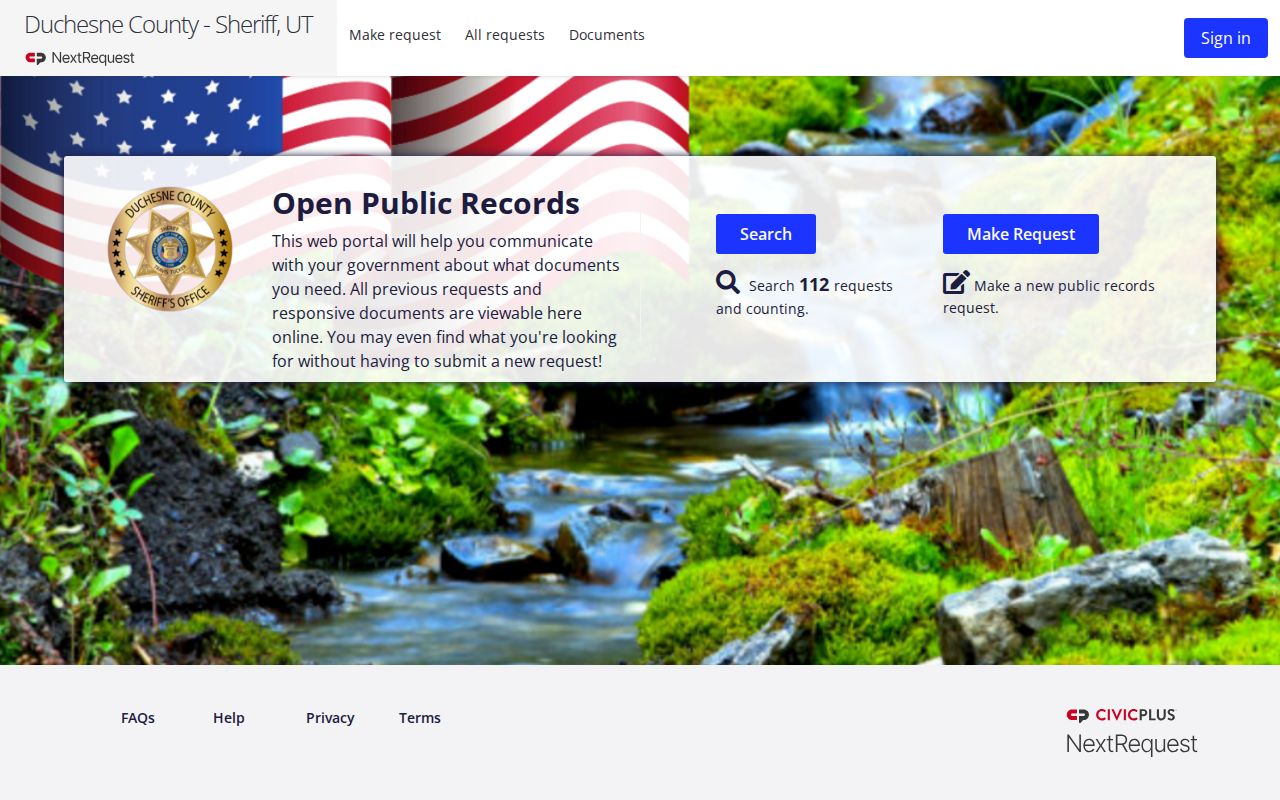
The portal is the documentary path when the jail phone cannot provide a public release detail or a written copy is needed.
Duchesne Release Records Under GRAMA
Utah’s Government Records Access and Management Act, known as GRAMA, starts with a right to inspect public records while classifying other material as private, controlled, or protected. Sections 63G-2-201, 63G-2-203, and 63G-2-204 cover access, reasonable cost-based fees, and request processing. Basic release facts may be public even when security, medical, investigative, juvenile, or personal details are withheld.
Expungement means sealing or limiting public access, not shredding every underlying record. An eligible record may disappear from public search after an automatic or court-ordered process under Utah Code Title 77, Chapter 40a. A no-result can therefore mean the record is not open to public inspection. It does not prove that no historic event occurred. Sheriff records are said in general to be kept for ten years, with some held indefinitely, but Duchesne does not tie booking and release entries to a specific archive schedule. Ask which retention series applies.
A missing online entry proves only that the source did not return it. It does not prove release, innocence, or destruction of the record.
Find Duchesne County Released Inmates
Begin with the government that had custody. Duchesne’s official jail page has no name search, current roster, or release archive. A local detainee therefore requires direct Sheriff and court checks. A sentenced Utah prisoner belongs in UDC and Board records, even when held in a county contract bed. A federal sentence belongs in the BOP locator. A noted immigration transfer calls for the ICE locator.
- Call the jail at 435-738-0190 with the full name, birth date or booking number, and approximate booking date. Ask whether the person entered the community or transferred.
- Search the matching Utah court case for a bond order, release order, dismissal, sentence, jail credit, warrant, or disposition.
- Submit a narrow Sheriff GRAMA request when oral confirmation is unavailable or a document is needed.
- If the entry shows a UDC transfer, search by UDC number or name and read the newest Board decision.
- Use BOP or ICE only when the local disposition or case identifies federal or immigration custody.
Duchesne publishes no live person roster. Disappearance from the county site cannot establish release because transfer, transport, or a hold may explain the change.
For a short same-day time span, the 24-Hour Release List explains how to frame a daily log request. Older and named-person checks should stay focused on the individual booking episode.
Search Duchesne State Releases
The UDC Offender Search covers people currently under UDC supervision. That includes state prison, felony probation, and parole. It excludes a county detainee who is only awaiting trial. A paroled person may still appear after leaving prison because UDC supervision continues. Someone who fully discharged may no longer be returned, so this is not an all-time release archive.
| Search item | How to use it | Limit |
|---|---|---|
| UDC number | Use it first when known to avoid name collisions. | It applies to the state corrections record. |
| First and last name | Enter at least one letter in each field and compare identity details. | Similar names require care. |
| Status or location | Read the exact label for prison, parole, probation, or office. | A supervision status is not full discharge. |
| Parole/Expiration Date | Use the live label and compare it with the newest Board order. | A future date may change before processing. |
The official search interface and its scope notice can be checked at the UDC search entry page.
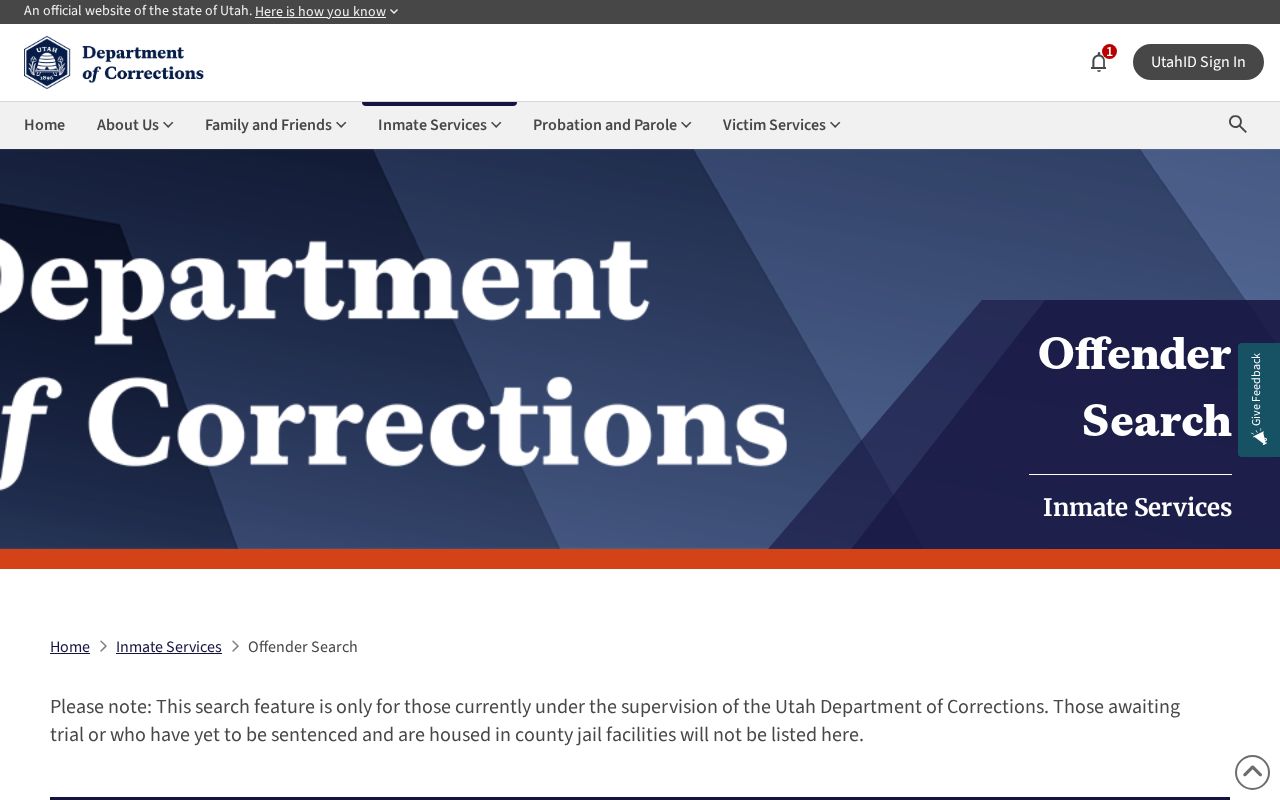
The screen helps identify the correct state record, but a Board order and UDC confirmation remain stronger for a scheduled or completed release.
Duchesne Release Court Searches
Duchesne release verification can require both district and justice court records. Utah district courts handle felonies and class A misdemeanors. Justice courts handle class B and C misdemeanors, local ordinances, and infractions. Duchesne County sits in the Eighth Judicial District. Search each plausible case because a release order in one matter does not remove a hold from another.
XChange is the statewide public case route for district and justice court data. Free public access is most reliably available at district courthouses and the State Law Library; check first before expecting a justice court terminal. MyCase is for parties viewing their own cases, not a general public name search. The docket can corroborate bond, recognizance, dismissal, time served, probation, or a warrant change. It usually cannot prove the exact hour jail staff finished release.
Duchesne Post-Release Pathways
Local Pre-Trial Monitoring and a state Community Correctional Center are not the same program. Duchesne’s monitoring path is tied to local jail or court control before the case or sentence is complete. A Community Correctional Center is a UDC placement for some people leaving state prison. UDC transports a person paroling to such a center rather than directing family to pick the person up.
Utah also separates the parole decision from supervision. The Board grants, changes, rescinds, or terminates parole. UDC Adult Probation and Parole supervises the person in the community, with Roosevelt listed as the relevant regional office for Duchesne County. A parolee is released from prison, yet remains under correctional authority until expiration or termination. The Parole & Probation page explains how to verify that status without mistaking it for discharge.
Duchesne Release or Custody Transfer
The Duchesne jail houses both county detainees and Utah state contract inmates. This mixed role creates an important false-release risk. UDC says people held in county jails are almost always moved to the Utah State Correctional Facility for state release processing. Direct state release from the contract jail is described as extremely rare. The end of a Duchesne jail entry may thus mark movement into another UDC site.
Ask one clear question: where did the person go next? The Sheriff transfer entry can show when Duchesne’s physical custody ended and identify a receiving agency. UDC and Board records then show whether state custody continued, changed to parole, or ended. If the receiving authority is federal or immigration, use that authority’s locator. Never convert “released from this facility” into “released to the community” without the destination.
Duchesne Release Alerts and Locators
Utah UDC participates in VINELink, which can provide custody-event notices for participating records. No Duchesne County source reviewed confirms that the local jail feeds VINE, so check the agency selector or ask the jail before relying on local coverage. Utah officials also warn that VINE notices may be inaccurate or missing. Treat an alert as a cue to verify with the reporting custodian.
The BOP inmate locator covers federal imprisonment and can retain a “Released” result with a date for many people released since 1982. ICE’s online locator is for immigration custody and may show a person recently released from ICE custody for a limited period. Neither tool proves release from the Duchesne jail. The Duchesne transfer record or the court case is the bridge that tells which federal system, if any, belongs in the search.
Compare Duchesne Release Sources
The same name may appear in several systems, but each source has a defined custody boundary. Use the source that owns the episode, then corroborate the transition.
| Situation | Primary source | What it can prove |
|---|---|---|
| Local jail episode ended | Duchesne Sheriff release record | Release time, disposition, and public destination fields |
| Local legal order | District or justice court case | Bond, sentence, dismissal, warrant, or probation order |
| State prisoner or parolee | UDC search and Board decisions | Current UDC status and the legal parole history |
| Federal prisoner | BOP locator | Federal custody or a reported federal release date |
| Immigration transfer | ICE locator | ICE custody or a limited recent-release trace |
Why is the person not online? Duchesne has no official person roster to retain or remove an entry. A no-result in another locator may reflect scope, spelling, discharge, sealing, transfer, or delay. Report it only as “not found in this source.”
Duchesne County Release Facilities
The local jail is the starting point for county bookings and also houses some UDC contract inmates. USCF is the usual processing point for state paroles and releases, including most people moved from contract beds. CUCF is a state prison and hearing site, while release processing generally shifts through USCF. BOP and ICE are nationwide custody systems rather than verified dedicated facilities in Duchesne County.
- Duchesne County Jail: confirm local release, monitoring, or transfer with the Sheriff and court.
- Utah State Correctional Facility: the usual UDC release and parole processing location.
- Central Utah Correctional Facility: a UDC confinement and Gunnison hearing site.
- Federal Bureau of Prisons facilities nationwide: use BOP for federal custody and release history.
- ICE detention network / non-dedicated local holds: use ICE only when immigration custody is indicated.